BaseVault

The AI-native home for your
private data.

Free · open source · no accounts, no backend, no subscription.

A desktop app that turns your files — notes, journals, PDFs, exports — into structured, traceable insight. No backend, no accounts, no telemetry.

Run it locally, or bring your own API key for a third-party, hardware-attested enclave. Either way, your machine verifies what's running before a byte leaves it — you don't trust the privacy story, you check it.

Download for macOS How the trust chain works

Local is free and offline. TEE uses your own API key — we never see it, and we never bill you.

Why this exists

Frontier-model capability, without giving up the privacy story.

Local inference is the cleanest privacy posture, but your laptop can't run a frontier model at speed. Hosted inference can — at the cost of handing your prompts to an operator who could read, log, or train on them.

TEE inference is the bridge. The model runs in a hardware-isolated enclave (AMD-SEV-SNP or Intel TDX) the chip keeps sealed from the cloud operator. Every call returns a cryptographic attestation that is verified before data is sent — so the privacy guarantee is rooted in silicon, not reputation.

And it isn't chat-on-top-of-embeddings. BaseVault builds a typed DAG of facts, patterns, and insights, each ref'd back to the byte its quote came from — so it scales past any single context window, and you read your data's structure instead of querying it.

● Local
Maximum privacy
Offline. Runs on your hardware. Quality bounded by your RAM/VRAM. Throughput: one worker.
~30 min on Apple Silicon
● TEE
Frontier capability, verified
Hardware-attested enclave. Frontier-grade models. Parallel fan-out across many workers. Trust is cryptographic, not reputational.
~2 min, 64 workers

See it

Three-pane workspace.

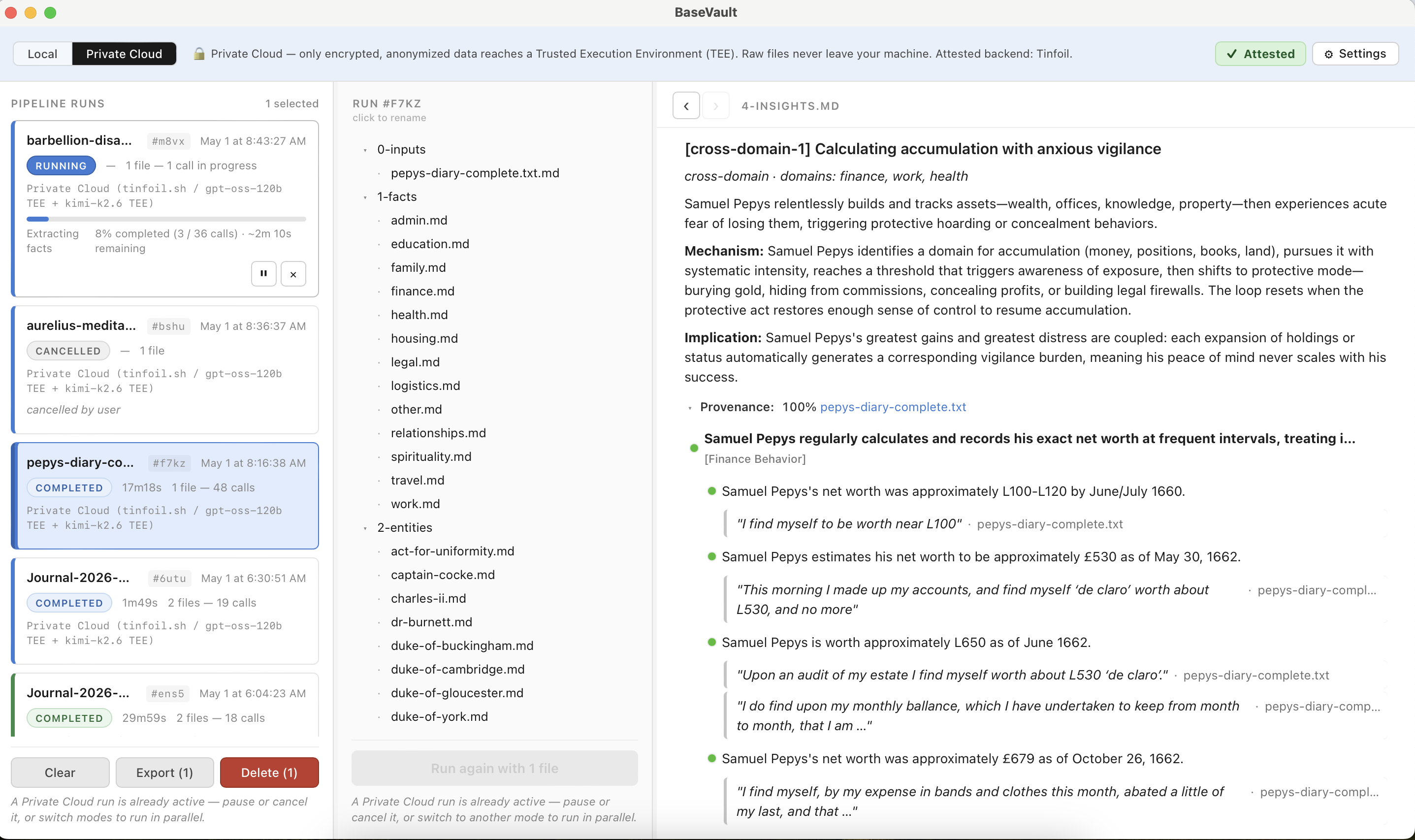
Pipeline runs on the left. The run's vault — inputs, facts, entities, patterns, insights, actions — in the middle. The markdown render on the right, with provenance trees that chain every claim back to the byte where its source quote lives. The "Attested" indicator at the top right verifies the TEE chain before any prompt leaves the machine.

BaseVault: three-pane workspace with runs panel, file tree, and markdown render. The top bar shows the Private Cloud (TEE) mode active with an Attested verification badge.

What it does

Ingest

Whitelisted formats: txt, markdown, PDF, docx, json, zip, images. Zips are recursively extracted. Images are transcribed via a vision model that matches the pipeline mode — they never cross trust boundaries.

Extract

Per-document metadata + per-chunk extraction into typed items (fact, decision, event, emotion, signal, open-loop). Each evidence span carries absolute byte offsets back into the original file.

Resolve entities

Mentions across facts are grouped by normalized name and type; a tiered resolver picks a single subject per run. Bundle inputs scrub the subject and synthesize per-file narrators so cross-file contexts don't collapse.

Patterns and insights

Within-theme patterns (mechanistic, with source facts), cross-domain insights (with source patterns), actionable recommendations with a harm-gate filter. Every layer carries refs back to the previous one. A walker traverses the DAG on demand.

Reproducibility

A prompt-hash cache makes the same input + model produce the same output bit-for-bit. Golden-hash regression tests fail at CI time if anyone slips non-determinism in. Pipeline changes are measured against held-out evaluation cases before they ship.

Resume + lifecycle

Detects the latest checkpoint and re-runs only what's missing. Pause / cancel / resume map to subprocess control. Local + TEE can run side-by-side for latency and quality comparison.

Empirical comparison

Same input. Different fidelity.

Staying local costs more than speed — it caps the model class you can run, and with it the structure that model can extract. Same corpus, same pipeline, run twice: local Ollama vs a TEE-attested frontier model.

● Local ollama · gemma4:e4b
Runtime
29m 59s
Items extracted
64
Dated items
42%
Conf ≥ 0.99 (overconfident)
19%
Patterns surfaced
12
Misc bucket "other"
22%
● TEE tinfoil · gpt-oss-120b + kimi-k2.6
Runtime
1m 49s
Items extracted
72
Dated items
99%
Conf ≥ 0.99 (overconfident)
0%
Patterns surfaced
18
Misc bucket "other"
11%
Directional, n=1 — not a benchmark. A single run on one personal journaling corpus. These numbers show a model-class delta, not a controlled measurement; read them as illustrative, not as a claim of general accuracy.

Same code ran both times — TEE didn't improve the pipeline, it just gave it a frontier-class model without giving up privacy. The delta you'd otherwise forfeit by ruling hosted inference too risky: 99% of items dated vs 42%, 50% more patterns, no overconfident claims, half as much landing in "other" — and ~16x faster.

Trust model

Cryptographic verification, not reputation.

● Local

Inference runs in Ollama on your machine. Nothing leaves your laptop. Trust surface is your hardware, your OS, the open-source inference binary, the published model weights, and the bundled Python pipeline.

● TEE

Inference runs in a Tinfoil-hosted hardware enclave (AMD-SEV-SNP or Intel TDX). The chip enforces that the compute stays sealed even from the cloud operator. Every call returns a cryptographic attestation that is verified before data is sent.

The chain, end-to-end

  1. 1. Enclave hardware produces a cryptographic quote — a signed measurement of the loaded code, rooted in AMD or Intel's silicon CA.
  2. 2. The quote is matched against the per-model deployment manifest published on the open-source tinfoilsh/confidential-<model> repository.
  3. 3. The deployment's SLSA provenance is verified via Sigstore (Fulcio + Rekor). The artifact must have been built by the expected GitHub Actions workflow, signed at build time, and recorded in Rekor's public transparency log.
  4. 4. Linux toolchain hashes (kernel, initrd, root filesystem) are measured into the same quote — the entire boot chain is verified, not just the model image.

Every verification — including raw quote bytes, the Sigstore bundle, and the Rekor inclusion proof — is logged to ~/.basevault/attestations.jsonl. You can grep it, audit it, and pipe it into other tools. The app also renders an exact gh attestation verify command per call so you can independently re-verify against GitHub's CLI.

Tinfoil is the provider today. Others will be added only as each clears a strict audit: attestation API surface, per-model manifest discipline, public build provenance, and SDK enforcement that refuses inference unless the chain verifies.

Read the full walk-through → — worked example with byte values, copy-paste verify recipes, and the in-app trust panel.

What you don't have to trust

  • The network. End-to-end encrypted to inside the enclave; the quote is signed at hardware level. No party in transit can read or alter your prompts.
  • The TEE provider as a company. Hardware isolation prevents them from reading prompts even with full server access. They could refuse to serve you (DoS); any model substitution or code change surfaces in the attestation chain rather than being silently deployed (see Auditability, not unilateral safety below).
  • A compromised release. Sigstore's transparency log is append-only and globally consistent — post-hoc edits are detectable.

Auditability, not unilateral safety

Attestation and transparency logs give auditability, not a unilateral guarantee of safety. Every measurement chains to a specific public commit in Sigstore's append-only log — anyone can fetch that source, diff it against prior releases, and judge it.

What still rests on trust is that the provider ships only code it's willing to defend in public — a narrower ask than "trust us not to read your data," and one that shrinks as reproducible builds mature.

And the app itself?

The chain above covers the enclave, where you have no local access. The .dmg is simpler — you have the bytes. Hash your download and match it to the SHA-256 on this page; the source is public, so you can read exactly what you're running instead of taking our word.

Beyond that you're trusting Apple Developer ID + notarization + this page's SHA — the same posture as any signed, notarized macOS app.

Philosophy

Personal data should stay where the person can see it. Most software does the opposite: your files feed someone else's cloud. BaseVault flips that — your machine is the engine, and the cloud, when used, has to prove what it's running before it gets your data.

When work has to leave your machine, proof should replace reputation. Not "trust us, we're a good company," but show me evidence I can verify without trusting you. Attestation, transparency logs, and reproducible builds are that evidence.

And every claim the model makes traces back to its source — insights to patterns, patterns to facts, facts to the byte their quote came from. No orphan synthesis: if it doesn't chain back to evidence, the pipeline doesn't emit it. That's enforced in the data model, and the code that touches your data is open source.
Download

macOS, Apple Silicon

Latest signed and notarized build. Apple Developer ID verified by Gatekeeper on launch.

Version
0.2.2
Released
July 1, 2026
SHA-256
50a6f330317869fd97161a5ab8007e223bf190a978648d2a05ab4641c3ac979d
Signing
Developer ID Application: BaseVault, Inc. (GB5PZY2Q63)

Release history → — what changed in each version.

Download .dmg

Verify before launching

# Before mounting:
shasum -a 256 BaseVault.dmg

# After mounting (double-click the .dmg first):
spctl -a -t exec -vv /Volumes/BaseVault/BaseVault.app
codesign -dv --verbose=4 /Volumes/BaseVault/BaseVault.app

The first command should match the SHA-256 above. The second should report accepted, source=Notarized Developer ID. The third shows the signing identity — verify the team identifier matches GB5PZY2Q63.

Contact

Get in touch.

Questions, feedback, or a security report: security@basevault.ai (disclosure details in security.txt). Source and issues: github.com/basevault-ai/basevault.